europe
Museum of Japanese Art
dutch museums
amsterdam exhibition guide
artists/exhibitions
franck gohier
Neil Emmerson
lawrence finn
Feminist Actions - Spacement
Nicola Kaye - PICA
wendy mcgrath
Basquiat
Banduk Marika
john nixon at CACSA
john peart
Gosia Wlodarczak
julie rraps pearl beach
North Atlantic House
Ruark Lewis
more orozco
ARS 06 –Sense of the Real
tom nicholson
Australia
barkly regional arts
Gheeraerts & Arcimboldo(re: archibald)
archibald winner 2006
2006 Contemporary Commonwealth exhibition - Melbourne
new media - taree
australian events in france 2006
printmaking
peter jansen
infidelitie
The Centre for Fine Print Research
Japanese Prints
bimpe reminder
non-toxic printmaking
calls: print media
depicture
call - biennial of engraving
goya's caprichos
print australia website
mike parr prints - MCA
polish prints
resources
Country Arts South Australia
artist statement
think quest
conferences/biennials
AAANZ conference
Emergency Biennale in Chechnya
31 March, 2006


30 March, 2006
Neil Emmerson
24HR Art.

Neil Emmerson - Paradise Lost March 31 - May 6 2006
Neil Emmerson's practice is based around printmaking, with his prints often incorporated into complex installations of diverse materials. A recurrent interest in Emmerson's work is the representation of masculinity and male sexuality. The artist draws connections between the varied and complex strands of male socialisation and interaction. His installations often bring together parallel narratives that operate in a single space.
Russell Storer. Curator, Museum of Contemporary Art. Sydney
Neil Emmerson has sidestepped, with finesse, the Utopic earnestness of American Queer just as he has the tyranny of an Australian scene that no sooner sees an evocation of gay desire than it dumps it in a basket named Gay Art and pops the lid back on. Indeed, as one of Australia's most intelligent installation artists, he has built up, over 20 years, a body of work unique in it's subtle poetics: what Foucault might call an ascesis - an ethics of living.
This exhibition by Neil Emmerson brings together work from a series of consecutive projects produced over the past 4 to 5 years.
(habit@t) 2002 and (the picnic) 2004 were produced in Newcastle NSW, (I was his...) 2005 and (paradise lost) 2006 were produced since living here in Darwin.
(habit@t) 2002 investigated a particular location, an ANZAC memorial garden in Civic Park, Newcastle where there was an obelisk, a fountain and a central lawn surrounded by a thicket of garden, edged with memorial plaques dedicated to soldiers from the local district who had their lives cut short by the second world war. This is not an unusual phenomena. In many cities, suburbs and country towns all around Australia there are similar monuments in local parks and gardens to commemorate the sacrifice of young men's lives to war. As with the garden in Newcastle it would perhaps not be unusual for these locations, generally abandoned at night, to be the site of other rituals of masculine celebration and interaction. Cruising for sex in parks and gardens is as old and ubiquitous as the celebration and memorialisation of war itself. The construction of masculinity within this present culture feeds off this idea of the heroic, young (heterosexual) male at war, at war with other young men. The double-barrel nature of the situation presented in these locations is provocatively illustrated in a short piece of text by Jean Genet: I was his at once, as if (who said that) he had discharged through my mouth straight into my heart.
Here is a clever, poetic (Queer) concoction, a conflation of rapture and confession, capture and surrender, that swings strategically between the literal and the metaphoric. This text continues to be used through the development of these related projects.
Following on from the initial engagement with the memorial garden in Civic Park Emmerson has extended this theme into the contemporary theatre of war as we are presented it through the news media in it's various forms. However the garden remains a focus and the idea of a memorial is a feature of each. Emmerson's critique of contemporary warfare has another thrust, one exhibiting the artist as delinquent or even (we think of Genet's Funeral Rites and the German soldier Erik buggering the young collaborator Rikon against a brick monument during the Fall of Paris), as outlaw lover. For the fact is that Emmerson has set his sights on a Queer desire for soldiers and thus the pathos of war. Such logic of course rudely displaces the symmetry of heterosexual binaries with what Leo Bersani describes as the “anti-relationality inherent in all homo-ness.”
(gallery pdf)
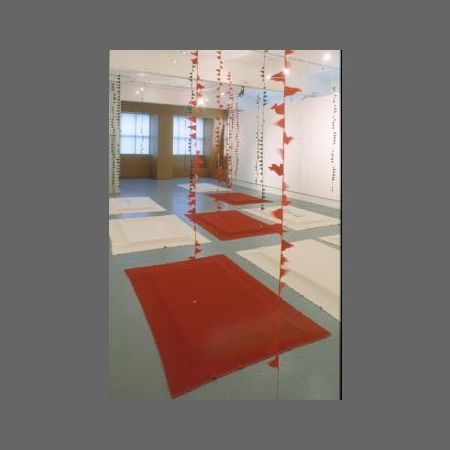
at william mora galleries

Neil Emmerson - Paradise Lost March 31 - May 6 2006
Neil Emmerson's practice is based around printmaking, with his prints often incorporated into complex installations of diverse materials. A recurrent interest in Emmerson's work is the representation of masculinity and male sexuality. The artist draws connections between the varied and complex strands of male socialisation and interaction. His installations often bring together parallel narratives that operate in a single space.
Russell Storer. Curator, Museum of Contemporary Art. Sydney
Neil Emmerson has sidestepped, with finesse, the Utopic earnestness of American Queer just as he has the tyranny of an Australian scene that no sooner sees an evocation of gay desire than it dumps it in a basket named Gay Art and pops the lid back on. Indeed, as one of Australia's most intelligent installation artists, he has built up, over 20 years, a body of work unique in it's subtle poetics: what Foucault might call an ascesis - an ethics of living.
This exhibition by Neil Emmerson brings together work from a series of consecutive projects produced over the past 4 to 5 years.
(habit@t) 2002 and (the picnic) 2004 were produced in Newcastle NSW, (I was his...) 2005 and (paradise lost) 2006 were produced since living here in Darwin.
(habit@t) 2002 investigated a particular location, an ANZAC memorial garden in Civic Park, Newcastle where there was an obelisk, a fountain and a central lawn surrounded by a thicket of garden, edged with memorial plaques dedicated to soldiers from the local district who had their lives cut short by the second world war. This is not an unusual phenomena. In many cities, suburbs and country towns all around Australia there are similar monuments in local parks and gardens to commemorate the sacrifice of young men's lives to war. As with the garden in Newcastle it would perhaps not be unusual for these locations, generally abandoned at night, to be the site of other rituals of masculine celebration and interaction. Cruising for sex in parks and gardens is as old and ubiquitous as the celebration and memorialisation of war itself. The construction of masculinity within this present culture feeds off this idea of the heroic, young (heterosexual) male at war, at war with other young men. The double-barrel nature of the situation presented in these locations is provocatively illustrated in a short piece of text by Jean Genet: I was his at once, as if (who said that) he had discharged through my mouth straight into my heart.
Here is a clever, poetic (Queer) concoction, a conflation of rapture and confession, capture and surrender, that swings strategically between the literal and the metaphoric. This text continues to be used through the development of these related projects.
Following on from the initial engagement with the memorial garden in Civic Park Emmerson has extended this theme into the contemporary theatre of war as we are presented it through the news media in it's various forms. However the garden remains a focus and the idea of a memorial is a feature of each. Emmerson's critique of contemporary warfare has another thrust, one exhibiting the artist as delinquent or even (we think of Genet's Funeral Rites and the German soldier Erik buggering the young collaborator Rikon against a brick monument during the Fall of Paris), as outlaw lover. For the fact is that Emmerson has set his sights on a Queer desire for soldiers and thus the pathos of war. Such logic of course rudely displaces the symmetry of heterosexual binaries with what Leo Bersani describes as the “anti-relationality inherent in all homo-ness.”
(gallery pdf)
at william mora galleries
franck gohier


franck gohier 06+ at ray hugues

Frank Gohier, of Red Hand Prints Studio.
at uni of wollongong
Franck Gohier
In 1991 Franck Gohier graduated with a BA (Fine Arts, majoring in printmaking) from the then Northern Territory University, where he also worked as a studio printmaker/lecturer between 1993-96. During this time, Gohier co-founded (along with Leon Stainer and George Watts) a series of groundbreaking printmaking workshops involving Indigenous artists from remote communities throughout the Top End and Desert regions of North Australia. The important links forged by this team of printmakers, between the University and several key Indigenous art communities, formed the foundation of the Northern Editions Printmaking Studio, recently described by former Chancellor Mrs Nancy Giese, AO OBE as ‘the jewel in the crown’ of Charles Darwin University.
In 1997, Gohier co-founded Red Hand Print Studio together with Shaun Poustie (also formerly of Northern Editions), an ideologically radical and independently spirited venture, which continued Gohier’s involvement with the tuition of printmaking skills to Indigenous communities, later extending this to prisoners at Berrimah Jail.
The range of Gohier’s creative accomplishments include intaglio and relief printing, painting, collage, sculpture and filmmaking. To this should be added his impressive history of poster production. In April 2004, the Charles Darwin University Art Collection confirmed its acceptance of seventy-nine (79) poster prints by Gohier dating from 1997-2002, emanating from the pioneering printmaking studio of Red Hand.
more from charles darwin uni
28 March, 2006
barkly regional arts
Barkly Regional Arts is a networking and resource organisation that responds to the cultural and artistic needs of the communities in the Barkly Region, an area covering 300,000 square kilometres. Based at Tennant Creek NT http://www.barklyarts.com.au/index.htm
Click on the 'Photo albums' heading and see photographs from several print workshops.


Click on the 'Photo albums' heading and see photographs from several print workshops.
Subscribe to:
Posts (Atom)