Showing posts with label Indigenous. Show all posts

11 December, 2007

Papunya Painting

28 Nov 2007 – 3 Feb 2008
Temporary Exhibition Gallery. Free.

Papunya Painting: Out of the Desert showcases the National Museum of Australia's extraordinary collection of Western Desert art.


An important exhibition "Papunya Painting: Out of the Desert" has just opened at the National Museum of Australia in Canberra. The Museum holds an outstanding collection of Papunya Tula art including many large canvases. Most of these paintings have never been seen in Australia in the three decades since they were painted.

They were mainly collected by the Aboriginal Arts Board (AAB) of the Australia Council, which was created in 1973. Amongst other things it provided grants for Aboriginal communities to employ managers and to help sustain Aboriginal culture and arts. Some of the Papunya paintings bought by the Board were lent or given to Australian embassies around the world while others were donated to public museums and galleries. These helped to raise the profile of Aboriginal art in the commercial art market.

In the 1980s the AAB wound up its exhibition program and in 1990 the collection of Papunya paintings was transferred to the Museum. These form the substance of this outstanding exhibition.

The exhibition is organized by the sequence of coordinators with Papunya Tula Artists starting with Geoffrey Bardon and going as far as Andrew Crocker at the beginning of the 1980s.

Follow the links below to learn more about the Papunya collection, the artists, exhibition catalogue and one of our many events and children's activities.

> The exhibition
> Works on show
> The artists
> Collection history
> Papunya map
> Behind the scenes
> Events and activities
> Catalogue
> Further reading

14 October, 2007

24th Telstra National Aboriginal & Torres Strait Islander Art Award


http://www.nt.gov.au/nreta/museums/exhibitions/natsiaa/index.html

Dennis Nona

Winner Telstra Award
Dennis Nona, Ubirikubiri, Cast bronze

Winner Terstra General Painting - Angelina George Winner Telstra General Painting
Angelina George, Near Ruined City, Synthetic polymer paint on canvas
Winner Telstra Bark Painting - Margaret Rarru Garrawurra Winner Telstra Bark Painting
Margaret Rarru Garrawurra, Ngarra Body Paint Design, Natural pigments on wood
Winner Telstra Work on Paper - Alick Tipoti Winner Telstra Work on Paper
Alick Tipoti, Gubau Aimai Mabaigal, Linocut on paper
Winner Telstra Wandjuk Marika 3D Memorial Award - Laurie Nilsen Winner Wandjuk Marika 3D Memorial Award (sponsored by Telstra)
Laurie Nilsen, Goolburris on the Bungil Creek, Barbed wire, steel, cast aluminium, sand, natural pigments


===================

Opening Night Winners’ Speeches


=========

NATSIAA Archives

2006 - 23rd Telstra National Aboriginal & Torres Strait Islander Art Award
2005 - 22nd Telstra National Aboriginal & Torres Strait Islander Art Award
2004
- 21st Telstra National Aboriginal & Torres Strait Islander Art Award
2003 - 20th Telstra National Aboriginal & Torres Strait Islander Art Award


Download for 2007

National Indigenous Art Triennial


13 October 2007 – 10 February 2008

http://nga.gov.au/NIAT07/index.cfm

The inaugural National Indigenous Art Triennial will be held at the Gallery in Canberra later this year. Presenting the work of thirty artists from each state and territory, the Triennial demonstrates the incredible range of contemporary Indigenous art practice. It is the largest survey show of Indigenous art at the Gallery in more than fifteen years, featuring up to four works by each artist created during the past three years in a variety of media, including painting on bark and canvas, sculpture, textiles, weaving, new media, photomedia, printmaking and installation. The works selected not only create an exhibition of outstanding quality but are also ultimately important acquisitions for the national collection.
Internationally, there has been incredible interest in contemporary Indigenous art from Australia, most notably with the prestigious Australian Indigenous Art Commission at the new Musée du quai Branly, Paris, in June 2006. And there can be no doubt that locally the launch of the Triennial is well-timed. Not only does it open the day after the Gallery’s twenty-fifth anniversary, it also coincides with the fortieth anniversary of the 1967 Referendum (Aboriginals), whereby non-Indigenous Australians (90.77%) voted overwhelmingly to include Indigenous Australians on the census as citizens, and the fiftieth anniversary of NAIDOC (National Aboriginal and Islander Day Observance Committee). These anniversaries are a major inspiration for the exhibition’s thematic context.

The Culture Warriors "big guns" | Exhibition launch | Selected works

Events Calendar | 25th Anniversary Events | NIAT Artists Talks


13 July, 2007

'Big Ones, Little Ones'

'Big Ones, Little Ones' is a collection of works by adults and children presented by Gallery Amichi and St Lucy's School, and hosted by the Hon Linda Burney MP.
The exhibition presents the work of Australian Indigenous artists and children from remote and isolated communities around the world; this includes art and stories from 27 schools in 15 different countries, including 13 schools in remote, regional and urban Australia. It connects communities, cultures and classrooms, giving children a voice through art.

The exhibition is open to the public, and on display from Tuesday 3 July to Friday 27 July 2007

http://www.parliament.nsw.gov.au

Parliament House
Macquarie Street
Sydney NSW 2000


29 June, 2007

Northern Editions Gallery


Dorothy Napangardi: etchings and screenprints 2001-2006
This exhibition showcases an exquisite selection of limited edition prints produced by celebrated Warlpiri artist Dorothy Napangardi between 2001-2006. Dorothy’s complex and beautiful prints depict Women’s Dreamings associated with her country Mina Mina.

Where: Northern Editions Gallery, Building 33, Casuarina Campus, Darwin.
When: Opening Thursday 28 June, 6pm. Showing Mon-Fri until 31 July.

=============
http://www.cdu.edu.au/northerneditions/gallery/albums.php

25 June, 2007

Cuisine & Country - Lake Macquarie


8 June 2007 to 22 July 2007

Cuisine & Country + satisfied

Food is an almost boundless source of inspiration – relishing produce, preparing a meal, sharing it (or not), a picnic, a campsite, slow food, fast food, drinking and feasting. Along with it comes a social atmosphere – an ideal catalyst for stimulating conversation.

Cuisine & Country is a visual feast teasing out the essential role food has played in Aboriginal and non-Aboriginal Australian life. Conceived and selected by independent curator Gavin Wilson, Cuisine & Country tells a new story about our nation.


Notables sharing their unique vision include Margaret Preston, John Olsen, William Dobell, Brett Whiteley, Fred Williams, Emily Kngwarreye, Yvonne Koolmatrie, Anne Zahalka, David Keeling, Euan Macleod and Ben Quilty.


In all, the exhibition consists of over 90 works – historic, modernist and contemporary - by 50 artists. It includes paintings, graphics and photography drawn from the National Gallery of Australia, the Art Gallery of New South Wales, the State Library of New South Wales and other major collections.

As the first venue of this extensive national tour, Lake Macquarie City Art Gallery will complement the exhibition with the project satisfied. Taking its cue from the successful 2002 project Satisfaction, satisfied showcases the making of a delicious three-course meal prepared by Awaba House’s award-winning chef, Daniel Lawrence, arranged on exquisite handcrafted tableware by Hunter practitioners Helen Dunkerley, Sue Jones and Won Seok Kim and photographed by Roger Hanley.

http://www.lakemac.com.au/page.aspx?pid=706&vid=13

08 June, 2007

24th Telstra National Aboriginal & Torres Strait Islander Art Award


Exhibition dates: Friday 10 August - Sunday 18 November 2007
Opening: 6pm Friday 10 August 2007

Museum and Art Gallery of the Northern Territory
Conacher Street, Bullocky Point, Darwin

http://www.nt.gov.au/nreta/museums/magnt/natsiaa/index.html

The 24th Telstra National Aboriginal & Torres Strait Islander Art Award, open to all adult Aboriginal & Torres Strait Islander artists, aims to showcase the very best Australian Indigenous art from around the country.

The non-acquisitive Telstra Award of $40,000 is awarded to the work considered by judges to be the most outstanding work in the exhibition. Additional prizes of $4,000 each are awarded in four media categories.

The four categories in which prizes are awarded are:

• the Telstra General Painting Award
• the Telstra Bark Painting Award
• the Telstra Work on Paper Award
• the Wandjuk Marika 3D Memorial Award (sponsored by Telstra)

The Telstra Award of $40,000 and the four media category prizes of $4,000 each are non-acquisitive.

The 2007 exhibition will feature 104 artworks in a wide range of themes, styles and media including painting on bark, canvas and paper, prints, sculpture, fibre art, ceramics, glass, photography, digital media and video.

NATSIAA archives

2006 - 23rd Telstra National Aboriginal & Torres Strait Islander Art Award
2005 - 22nd Telstra National Aboriginal & Torres Strait Islander Art Award
2004
- 21st Telstra National Aboriginal & Torres Strait Islander Art Award
2003 - 20th Telstra National Aboriginal & Torres Strait Islander Art Award

NAIDOC week 2007


NAIDOC celebrations are held around Australia in the first full week in July to celebrate the history, culture and achievements of Aboriginal and Torres Strait Islander people.

NAIDOC originally stood for ‘National Aborigines and Islanders Day Observance Committee’. This committee was once responsible for organising national activities during NAIDOC Week (see History of NAIDOC), and its acronym has become the name of the week itself.

The week is celebrated not just in the Indigenous community, but also in increasing numbers of government agencies, schools, local councils and workplaces.

View ideas on how to celebrate NAIDOC Week.

In addition to the many local activities, NAIDOC celebrations traditionally have a ‘national focus’:

  • a national focus city or town is chosen - for 2007 it is Darwin, Northern Territory
  • celebrations are based on a national theme - the theme for 2007 is 50 Years: Looking Forward, Looking Blak
  • a national NAIDOC poster based on the theme is distributed, chosen from entries to the NAIDOC Poster Competition
  • celebrations culminate in an awards ceremony and ball held in the focus city - in 2007 the National NAIDOC Awards and Ball will be held at SkyCity Casino, Darwin on Black Friday, 13 July 2007
  • at the ball, national awards are given to Indigenous achievers in a number of categories.
=====================
http://www.naidoc.org.au/award_winners/poster/poster_win07.aspx

Tyeli Hannah is the winner of the 2007 NAIDOC Poster Competition. Tyeli is a graphic designer for VIBE Australia, an Indigenous media company based in Sydney.


View winning entry as poster - (463kb PDF)

Click here to Order your National NAIDOC Posters.

==================


The Australian Aboriginal Flag was designed by artist Harold Thomas and first flown at Victoria Square in Adelaide, SA, on National Aborigines Day, 12 July 1971. It became the official flag for the Aboriginal Tent Embassy in Canberra after it was first flown there in 1972.

Since then, it has become a widely recognised symbol of the unity and identity of Aboriginal people.

In view of the flag’s wide acceptance and importance in Australian society, the Commonwealth took steps in 1994 to give the flag legal recognition. After a period of public consultation, the Aboriginal flag was proclaimed a ‘Flag of Australia’ under section 5 of the Flags Act 1953 in July 1995.

In 1997 the Federal Court recognised Harold Thomas as the author of the flag.


The Aboriginal flag is divided horizontally into halves. The top half is black and the lower half red. There is a yellow disk in the centre of the flag.

The meaning of the three colours in the flag, as stated by Harold Thomas, is:

  • Black - represents the Aboriginal people of Australia
  • Red - represents the red earth, the red ochre used in ceremonies and Aboriginal people’s spiritual relation to the land
  • Yellow disk - represents the Sun, the giver of life and protector

The Aboriginal flag should be flown or displayed with the black at the top and the red at the bottom.

04 June, 2007

Brook Andrew


Being defined as Aboriginal in contemporary Australia has its blessings. There is infrastructure to support indigenous art. But it raises issues of classification, an almost anthropological way of looking at an artist. Andrew, while acknowledging the pluses, and admiring Pizzi's support of the multitude of forms coming out of indigenous Australia, is uncomfortable with the contemporary cliche of being black.

"Being Aboriginal is my identity," he says. "What I don't like about being labelled as an Aboriginal artist is that it boxes me into the ways in which people think I should create art and especially, always being placed within Aboriginal shows only. Like any stereotype, it has its disadvantages.

"I love who I am and my cultural being, but within the art world, I (and there are others, like Tracey Moffatt) want to be recognised as just an artist who works hard for their own work to be expressed and made without a particular type of mentality which surrounds our work and subjects. Sure, some subjects refer to our Aboriginality, but it doesn't bind us.'

"People say there are advantages of being labelled Aboriginal, but I think this is a racially motivated stereotype."

http://www.theage.com.au/articles/2004/03/31


http://www.nga.gov.au/Retake/artists/00000000.htm


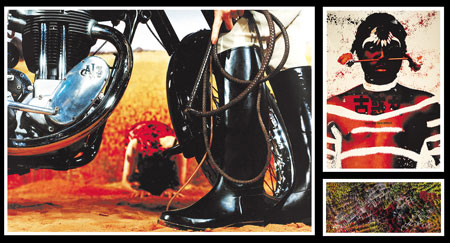
Brook Andrew has always been uncomfortable about being labelled an 'Aboriginal artist'. His latest work, nevertheless, centres on the politics of Aboriginal Australia within an international context. The pivotal work in Hope & Peace is a collage/screenprint of Indigenous footballer-turned-boxer Anthony Mundine, arms raised, Christ-like. Under each arm, cigarette boxes with the twin messages 'hope' and 'peace' float on towers of block capital letters, with psychedelic patterns of black and white behind. The colours are almost neon in their flat loudness the rainbow of Mundine's arms, the billboard-style lettering and the inclusion of that emblem of commercialism, cigarettes scream a pop-art aesthetic.

http://www.artlink.com.au/articles.cfm?id=2258


http://www.eaf.asn.au/ex01.html


http://www.kooriweb.org/foley/great/art/article10.html


http://www.fineartforum.org/Gallery/cybertribe/spirit+vision/langton.htm

28 May, 2007

Winchester Cathedral


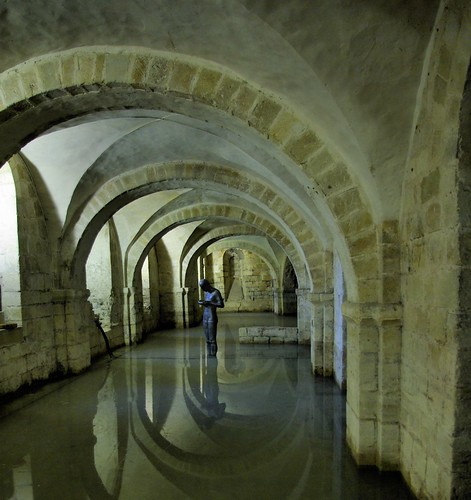
The sculpture, Sound II, in the North isle of the crypt under Winchester Cathedral in Winchester, England is normally calf-to-knee deep in water. Note the waterlines on the camera-right wall. The artist, Anthony Gormley designed the sculpture for that environment.


Winchester Year of Sculpture 2007
http://www.soton.ac.uk/yearofsculpture/


Light
Winchester Cathedral
3 May to 31 July 2007

This major exhibition of contemporary sculpture will include work by Darren Almond, David Batchelor, Ian Dawson, John Gibbons, Pilar Beltran Lahoz, Marc Quinn and Turner Prize winner Rachel Whiteread. The works have been selected for specific locations within the cathedral and although none have been commissioned for the site the location plays a significant role in how the works and building are interpreted.

http://www.yearofsculpture.com


Pilar Beltran Lahoz's Container, a series of silk screens with the markings of a freight container.

http://news.independent.co.uk/uk/this_britain/article2504633.ece

+++++++++++++++++++++++++++++


Winchester Cathedral Architecture
85 photos with architectural notes
http://www.astoft.co.uk/wincathext.htm


27 May, 2007

Bath Abbey


http://www-staff.it.uts.edu.au/~jenny/photos/2006/uk2006n/index.html


http://www.rock-hill.k12.sc.us/teachers/rhhs/jgarner/landscapes_of_england_files/bath.htm


http://www.travelsinireland.com/england/england/bath.htm


This is a video of the inside of the Bath Abbey in Bath, England
http://www.youtube.com/watch?v=29grZSzbAyk

Bath, England
http://www.youtube.com/watch?v=P48U1KfhIT0


We hope that these pages, which can be accessed via the menu to the right or by clicking on areas of the map below, will give you just a taste of what can be seen during a visit to the Abbey.

http://www.bathabbey.org/tour/


Australian flag above a wall tablet to Admiral Arthur Philip (1738-1814), founder of Australia’s first penal settlement and first Governor of New South Wales.

25 May, 2007

Long Man


Until recently the earliest record of Europe’s largest representation of the human form was in a drawing made by William Burrell when he visited Wilmington Priory, nestling under the steep slopes of Windover Hill, home of the 235 feet high Wilmington Giant. In 1993, however, a new drawing of the Long Man was discovered, made by surveyor, John Rowley, in 1710.

The new drawing has confirmed some theories and dispelled others. It suggests that the original figure was a shadow or indentation in the grass rather than a solid line; there were facial features that are no longer visible; the staffs being held were not a rake and a scythe as once described and the head was once a distinctive helmet shape, giving credence to the idea of the figure as a helmeted war-god.

Until the 19th century the Long Man was only visible in certain light conditions and after a light fall of snow, but in 1874, it was marked out in yellow bricks.

http://www.sussexpast.co.uk/property/printview.php?site_id=13


Cerne Abbas Giant


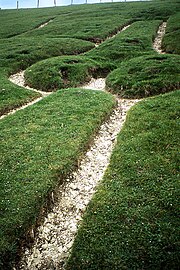
The Cerne Abbas Giant or the 'Rude Man' is the largest hillfigure in Britain, he (the figure's gender is beyond doubt) is one of two representations of the human form, the other being the Long Man of Wilmington in East Sussex. The giant, carved in solid lines from the chalk bedrock measures in at 180 feet high, and carries a huge knobbled club, which measures 120 feet in length.

The first written record of the giant appears in 1751 in a letter by Dorset historian John Hutchins, he suggested
that the figure was cut in the mid 1600's.

http://www.mysteriousbritain.co.uk/majorsites/cerne_abbass.html


Just above the giant's head is a small Iron Age earthwork which encloses a roughly square piece of land, this is known as the 'Frying Pan' or the 'Trendle' and it was within this enclosure that the Mayday Maypole was erected during the festival celebrations. Like many traditional village Maypole ceremonies this practice died out in the 19th century.


Indigenous Australian Art Commercial Code of Conduct


‘Secret and sacred’ refers to information and material that is restricted under Aboriginal customary law. This may be information and material that:
 is made available only to the initiated, used for a particular purpose and/or used at a particular time
 can only be seen and heard by particular clan members (such as men or women or people with certain knowledge), and
 is considered to be secret or sacred by the community to which it pertains.

Winikoff continued, “Many items of a secret sacred nature currently in collections, were acquired without the consent of the family members and/or the traditional owners. They and their descendants continue to suffer cultural damage through the non-repatriation of these objects.

http://www.visualarts.net.au/files/Media%20Release%2022May07.pdf

The Indigenous Australian Art Commercial Code of Conduct, currently nearing completion, outlines the following in relation to the treatment of secret sacred material:

 where possible the relevant community from whom the cultural property was aken should be identified and notified
 consultation should occur to establish the community’s willingness to receive custodianship of secret sacred remains and cultural property
 where repatriation is requested arrangement should be made in consultation with the relevant communities
 appropriate policies for the handling of secret and sacred material once it is identified should be determined and implemented in consultation with the relevant Traditional Owners
 galleries, private dealers and collectors should not engage in the sale of sacred or secret material”.


To read extracts from the Code relating to commercial dealings in secret sacred material download here .

http://www.visualarts.net.au/files/auction.pdf

09 May, 2007

Mossley

In 47 AD, when the Romans reached the Fosse line, the kingdom of Brigantia came under Roman rule, and suffered strict and oppressive measures after the Brigantian revolt of 68 AD. Tameside featured on the road which the Romans built from Manchester to Leeds and a branch to the fort at Melandra ran through the northern part of Mossley, within the present Borough.
After Roman withdrawal from Britain in 410 AD, various petty invasions and squabbles between local warlords took place, and by the 7th century Anglian immigrants had moved into the region and occupied the land.
Most of the place names of Tameside reflect this influence. The River Tame itself (probably Norse meaning "dark river"), and other places such as Werneth Low ("a place growing alder trees") as well as Ashton and Denton (the Scandinavian word "ton" indicates a town or settlement) - all show clear Anglian-Continental sources.
Oddly, there seems to be little evidence of native British place naming within the borough, suggesting that the Anglian invaders were its first inhabitants and it had been hitherto unoccupied woodlands.

http://www.manchester2002-uk.com/towns/tameside1.html


=======================

http://www.ashton-under-lyne.com/mossley.htm

The small Pennine town of Mossley lies just over the hill from Ashton under Lyne. The character of the town is very different, with its steep streets and stone houses.

Before it became a borough in 1885, Mossley was divided between three counties. Brookbottom (Top Mossley) and Bottoms (Bottom Mossley) were in Lancashire. This part of the town was historically part of the old parish of Ashton. Quickedge, Milton and Roughtown were in the West Riding of Yorkshire. The part to the east of the River Tame, including Micklehurst, was in Cheshire. The borough became part of Lancashire until 1974, when it became part of the Metropolitan Borough of Tameside.

High on the eastern sky-line of Mossley is Buckton Castle, an iron age hill fort. The remains of the defensive ridge and ditch are still to be seen. Below it, and forming a boundary between the steep moorland and the enclosed fields, an ancient road way runs around the hillside. The Romans made use of this road and paved part of it, using it as a route between the camps of Melandra (Glossop) and Castleshaw (Saddleworth).

The area was at one time densely forested but over many years, the trees were mostly felled and the hillsides used to graze sheep. Wool production became the chief industry, with many weaver's cottages being built, incorporating a weaving room. When powered looms were invented, woollen mills and later, cotton mills were constructed in the valley.

The earliest settlements in the area, such as Brookbottom and Roughtown, were high above the valley of the River Tame. With the building of the canal and later the railway, along with the mills being constructed along the valley bottom, Mossley spread out to fill the valley.

Although textile production has ceased, many of the mills are now used for other purposes, while others have been replaced by modern factories. Mossley has a well-used railway station and the Huddersfield Narrow Canal, closed for fifty years, has recently been re-opened.


Buckton Castle is a medieval ringwork/a good example of a Norman motte and bailey castle and is likely to have been constructed in the 12th century on the site of a prehistoric hillfort.
http://carrbrookvillage.users.btopenworld.com/buckton.htm

Greater Manchester Archaeology Unit, based at Manchester University, is due to do a dig at Buckton Castle in 2003- 2004. A pocket book history of Buckton Castle is due to be published in 2004-2005.
  • In 1536 beacons were lit at Buckton Castle as a march on foot to plead for the monasteries invited people to join in the enterprise. The King scattered the rebels by force!
  • In 1558 the beacons were lit to warn people of the approaching Spanish Armada and to signal the militia to assemble!
  • Buckton Castle is the place where in 1730 the people of Carrbrook dug expecting to find buried treasure!
  • =================
    Redeposited ditch material was identified overlying charcoal and peat layers which were carbon dated to AD 765-1010;AD 700-1000 & AD 570-765. It appears that this site is also assumed to be an Iron Age hill fort.


    http://homepage.mac.com/philipdavis/English%20sites/2929.html

    =================
    http://www.megalithic.co.uk/article.php?sid=4774

    Other sites nearby: ( * = Image)
    OLD: Pop-up a map of these sites
    NEW: View this page with an embedded Yahoo Map
    NEW: Download or link to a GeoRSS feed of these sites
    1.8km S Harridge Pike Cairn (SJ994999)
    3.7km S Stalybridge Cairn* Cairn (SJ989980)
    3.7km S Hobson Moor Cairn I Cairn (SJ990980)
    4.5km S Buckton Edge Cairn (SJ989972)
    4.5km S Hobson Moor Cairn II Cairn (SJ991972)
    5.8km N Delph Tumulus Round Barrow(s) (SD980074)
    7.3km SE Mouselow Castle Hillfort (SK027954)
    7.5km N Jackson's Barrow* Round Barrow(s) (SE00200905)
    7.9km E Highstones earthwork* Misc. Earthwork (SK064990)
    7.9km E Holgate Howe Cup & Ringmarks Cup and Ring marks / Rock Art (SE064044)
    8.4km E Holgate Howe Barrow Round Barrow(s) (SE067048)
    8.5km S Hangingbank, Werneth Low* Ancient Village or Settlement (SJ965935)
    8.6km S Lower Higham Farm Cairn (SJ961935)
    8.7km S Werneth Low Enclosure Ancient Village or Settlement (SJ970932)
    8.8km S Hargate Hill* Standing Stone (Menhir) (SK01239315)
    9.0km S Werneth Low Cairn Cairn (SJ969929)
    9.1km E Black Hill Cairn (SE074051)
    10.4km S Ludworth Intake* Round Barrow(s) (SJ990913)
    10.8km S Brown Low* Round Barrow(s) (SJ988909)
    10.9km S Robin Hood's Picking Rods* Ancient Cross (SK006909)

    ===========
    Legend has always told that great treasure existed beneath the grounds of this Brigantian hillfort, found on the moor-edges to the east of Manchester. Long ago, one man came along to see if he could find the treasure, said to consist of a huge chest of gold. The man brought two horses and the ground within the fort was gradually cleared away until, to the man's surprise, the legendary chest was revealed!

    Attaching chains to it and the horses, the man shouted:

    "Gee, whoa, whoo! Bonny, Buck and Bell,
    I'll have this chest o' gowd, i' spite o' all t'devils in hell!"

    But barely had the words left his mouth and the chest began to move, when the devil himself appeared in the shape of a huge hen that breathed fire! This scared the horses so much that they bolted and snapped the chains, taking their master with them but leaving the treasure-chest still in the ground. To this day the chest still remains, hidden in the Earth.

    Source:
    Winterbottom, Vera, The Devil in Lancashire, Cloister: Stockport 1962.
    http://www.themodernantiquarian.com/site/8663

    ============


    Hartshead pike serves as a focal point in the Oldham landscape, visible from miles around with unbroken views across 4 counties. This has been a beacon hill through antiquity.

    Before the Romans the local tribes lit fires here to celebrate the cycle of the seasons, there were many ancient sites close by, including a stone circle at Buckton Castle, once visible from the pike it is now sadly lost. It is highly probable that the druids worshiped at Hartshead Pike during the Iron Age, and sacrifices may have been held to appease their gods.

    During the Roman occupation the area took on a more mundane role and became a beacon site, the trackways became routes for the Romans to navigate quickly between the fort at Buckton, and the Roman road at Limeside. The beacon may have been lit in times of unrest to warn the local garrisons.

    After the departure of the Romans much of Oldham was inhabited by the Anglo Saxons. There has been some suggestion that the pike was the site where they held their mote (moot) - to appoint leaders and to create law, and the name Hartshead may come from their habit of marking a meeting place with the skull of a wild animal (although this is pure speculation).

    In more recent times the pike has been the scene for UFO sightings collected by researchers in the area, although some of the distant sightings may have been misidentified aeroplanes landing at Manchester Airport.

    http://www.mysteriousbritain.co.uk/england/greatermanchester/grtman1.html

    ============

    Since 1990, the University of Manchester has been involved in a long-term survey and research project of Tameside, funded by the council, with the aim of assessing existing archaeological evidence and using it to identify new areas of likely archaeological interest.

    http://www.tameside.gov.uk/corpgen/millennium/yearbook10.html


    The first three volumes cover the Prehistoric, Roman and Dark Age periods prior to 1066, the medieval and early post-medieval communities of Tameside between the centuries from 1066-1700, and the industrial period covering the years 1700 to 1930. Those have been followed by a volume dealing with the formative historical personalities of the area and another dealing with the borough's historic buildings and structures.

    ===========


    Sites and Buildings of Interest
    http://www.tameside.gov.uk/corpgen/millennium/yearbook11.html


    =============

    "Scout Tunnel in Mossley is the only tunnel in Tameside and is 200 yards long. If you were to stand at the top of Scout Tunnel looking towards the railway line in the direction of Woodhead Tunnel, there you will see on the hillside a horse which is cut out of heather."

    http://www.mossleyonline.co.uk/local_info/info_know.html


    ==================


    The Blue Plaque at Gorse Hall Estate, Stalybridge, celebrates the site of Gorse Hall which was built by Beatrix Potter's maternal grandparents, John and Jane Leech. Beatrix often visited Gorse Hall with her mother, Helen Leech.
    Beatrix Potter Gorse Hall Estate, Stalybridge

    ========

    Welcome to the official web site of The Mossley Band - the Championship Section brass band with an incredible history spanning over 150 years.
    http://www.mossleyband.co.uk/


    The Mossley Band 1961

    ============

    The Brewery -The Millstone Brewery restores a traditional craft to the town of Mossley, situated where the counties of Cheshire, Lancashire and Yorkshire meet. Vale Mill, originally part of Mossley’s cotton heritage, provides an appropriate home for the eight-barrel plant that was installed in September 2003. Brewing commenced in early October.
    http://www.millstonebrewery.co.uk/

    ================
    Long Live the Fish and Chip Shop
    Along with the history of fish and chips comes the colourful history of the fish and chip shop.

    The first fish and chip shop in the North of England is thought to hove opened in Mossley near Oldham, Lancashire, around 1863. Mr Lees sold fish and chips from a wooden hut in the market and later he transferred the business to a permanent shop across the road which had the following inscription in the window "This is the first fish and chip shop in the world."

    But in London, Joseph Malin opened a fish end chip shop in Cleveland Street within the sound of Bow Bells 13 in 1860

    http://www.niagara.co.uk/fish_and_chips.htm

    =====================
    About the Roaches Lock * Music Venue

    The Roaches Lock Inn stands in a picturesque setting between the Huddersfield narrow canal and the river Tame in Mossley, near Ashton, Manchester UK

    Live music - every Friday and Saturday

    Large beer garden on the canal side * Non smoking dining area

    Real ales - and decent wine...

    Gig requests,
    Please send Band details and sample CD to the following address.

    Roaches Lock Inn,
    387 Manchester Road, Mossley,
    Lancashire,
    OL5 9BB

    Tel. number 01457 834288

    http://www.roacheslockinn.co.uk/

    ================

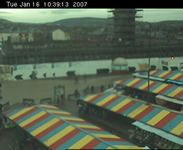
    Ashton Market Hall Webcams

    Thumbnail view of Webcamera1 at Ashton Market Hall Thumbnail view of Webcamera2 at Ashton Market Hall

    View a larger image of webcam1 View a larger image of webcam2

    These webcam views show regularly updated images every 5 minutes of work in progress within Ashton Market Hall.

    As you can see, work has commenced on the restoration of our historic Market Hall which was gutted by fire in May 2004. Contractors employed by Tameside MBC have started the enabling works to allow the main contract to follow on and the work is expected to be completed by late Spring 2008.

    20 April, 2007

    Indigenous art - dot technology

    It is hoped a series of tiny dots will protect thousands of Australian Indigenous artworks and artists from fraud and exploitation.

    Former Northern Territory government minister Peter Toyne is an executive with Alice Springs-based company IdenteArt, which developed the technology alongside the CSIRO.

    The artwork is protected by microscopic dots that stores information about the artist and the gallery or art centre where the work was made.

    The information will then be stored on a national database held in trust by the Federal Government.

    The dots are either sprayed onto a tamper-proof label or directly onto the works themselves.

    Dr Toyne says about 12,000 Indigenous artworks are in the process of being protected by the dots.

    "The glory of it is that it's so flexible that you can actually spray this code onto basketware or pottery or boomerangs or didgeridoos as well as embodying it into a label attached to the back of paintings," he said.

    Dr Toyne says the industry had to develop a solution to the unethical practices in the Indigenous art world.

    "There'll be a fence line thrown up around 3,500 artists and 12,000 Indigenous works of art initially, and that fence line defines safety and fair returns for their work compared to the rest of the market, which will have all of the collection of ethical and unethical trading," he said.

    He says the initiative also aims to employ Indigenous workers.

    "[It will] create about 125 jobs for Indigenous people, largely in remote communities," he said.

    "[They will be] actually putting the authentication on the works and registering the works on a national and international database that will support the tracking of these works through the market."


    13 April, 2007

    Tjarlirli Art at Gallery Gondwana


    Work from one of the newest Aboriginal Art Centres in the region, Tjarlirli Art from Tjukurla in Western Australia, will be featured in Gallery Gondwana’s Autumn Exhibition.
    http://www.gallerygondwana.com.au/Naive/Naive%20Alice%202007/Naive2007.htm

    Named after one of three sacred rock holes near Tjukurla that has special significance to the women of the region, Tjarlirli Art was formed in June 2006 out of a desire to draw people back to their birthplace from the communities of Docker River (to the south) and Kiwirrkura (to the north). The paintings will be available for viewing on the web from 17 April.

    More info: www.gallerygondwana.com.au
    Opening: Saturday 14 April 3pm
    14 April – 20 May at Gallery Gondwana, Todd Mall, Alice Springs

    ============

    Tales from the Bush

    We start our year with this charming exhibition of work by acclaimed artists of this genre includes Bessie Liddle, Peggy Jones, Billy Benn and other great work from the communities of Titjikala, Julalikari, Bindi, Tjampi, Hermannsburg and Ikuntji. The work represents a serene world of simplicity, scenes of everyday life, country and memories depicted with a love of colours and shapes.

    :: BESSIE LIDDLE
    :: Titjikala
    :: Bindi
    :: Ikuntji
    :: Julalikari

    ::
    Hermannsburg


    12 April, 2007

    australia - prints


    Mount Arapiles - sunset. 1865
    http://cs.nga.gov.au/Detail-LRG.cfm?IRN=73074&View=LRG


    Simon: An Australian Aboriginee of the Yarra Yarra tribe which opposed the landing of Batman 1835
    http://cs.nga.gov.au/Detail-LRG.cfm?IRN=80186&View=LRG


    Diggers licensing, Forrest Creek. 1852
    http://cs.nga.gov.au/Detail-LRG.cfm?IRN=145128&View=LRG


    First exhibition held in the museum, Sydney, N.S.W.1855.Taken from a daguerreotype by Gow, 384 George Street.
    http://cs.nga.gov.au/Detail-LRG.cfm?IRN=23201&View=LRG


    Night fishing 1865
    http://cs.nga.gov.au/Detail-LRG.cfm?IRN=40592&View=LRG


    The Derby Day at Flemington. 1890
    http://cs.nga.gov.au/Detail.cfm?IRN=127715

    wikipedia wars

    Who would have thought that Australian women had the vote 60 years before the UK and USA? Similarly, Australian women artists have led the way in feminist art.


    I don't, as a norm, cite wikpedia as a reference. ie Wikipedia could be described as knowledge by popular consensus. So even though the information I cited was from there in my recent comment on WACK, I didn't note the source.

    http://www.moca.org/wack/

    http://www.moca.org/wack/?p=145#comments

    Seeking to remedy my ommission, I went back to wikipedia today to discover that the record has apparently
    been re-written.

    From memory, this is not the page I cited last week.
    http://en.wikipedia.org/wiki/Timeline_of_women%27s_suffrage

    Whilst I note that the Australian record on wikipedia is largely as yet unwritten, I
    also note with concern that the current information presents an unfavourably biased paradigm particularly in relation to indigenous affairs.


    with disappointment

    b
    =============


    The timeline below lists years when women's suffrage was enacted in various places. In many cases the first voting took place in a subsequent year.
    http://en.wikipedia.org/wiki/Timeline_of_women%27s_suffrage