25 May, 2007

Cerne Abbas Giant


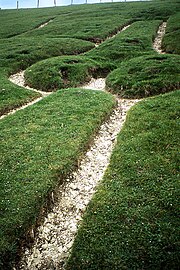
The Cerne Abbas Giant or the 'Rude Man' is the largest hillfigure in Britain, he (the figure's gender is beyond doubt) is one of two representations of the human form, the other being the Long Man of Wilmington in East Sussex. The giant, carved in solid lines from the chalk bedrock measures in at 180 feet high, and carries a huge knobbled club, which measures 120 feet in length.

The first written record of the giant appears in 1751 in a letter by Dorset historian John Hutchins, he suggested
that the figure was cut in the mid 1600's.

http://www.mysteriousbritain.co.uk/majorsites/cerne_abbass.html


Just above the giant's head is a small Iron Age earthwork which encloses a roughly square piece of land, this is known as the 'Frying Pan' or the 'Trendle' and it was within this enclosure that the Mayday Maypole was erected during the festival celebrations. Like many traditional village Maypole ceremonies this practice died out in the 19th century.


Indigenous Australian Art Commercial Code of Conduct


‘Secret and sacred’ refers to information and material that is restricted under Aboriginal customary law. This may be information and material that:
 is made available only to the initiated, used for a particular purpose and/or used at a particular time
 can only be seen and heard by particular clan members (such as men or women or people with certain knowledge), and
 is considered to be secret or sacred by the community to which it pertains.

Winikoff continued, “Many items of a secret sacred nature currently in collections, were acquired without the consent of the family members and/or the traditional owners. They and their descendants continue to suffer cultural damage through the non-repatriation of these objects.

http://www.visualarts.net.au/files/Media%20Release%2022May07.pdf

The Indigenous Australian Art Commercial Code of Conduct, currently nearing completion, outlines the following in relation to the treatment of secret sacred material:
“
 where possible the relevant community from whom the cultural property was aken should be identified and notified
 consultation should occur to establish the community’s willingness to receive custodianship of secret sacred remains and cultural property
 where repatriation is requested arrangement should be made in consultation with the relevant communities
 appropriate policies for the handling of secret and sacred material once it is identified should be determined and implemented in consultation with the relevant Traditional Owners
 galleries, private dealers and collectors should not engage in the sale of sacred or secret material”.


To read extracts from the Code relating to commercial dealings in secret sacred material download here .

http://www.visualarts.net.au/files/auction.pdf

24 May, 2007

Turner Prize 2007


Tate has now announced the four artists who have been shortlisted for the Turner Prize 2007. The artists are Zarina Bhimji, Nathan Coley, Mike Nelson and Mark Wallinger. This is the first time that the Turner Prize has been presented outside London since it began in 1984, and is a curtain-raiser for Liverpool European Capital of Culture 2008.

The Prize, established in 1984, is awarded to a British artist under fifty for an outstanding exhibition or other presentation of their work. It is intended to promote public discussion of new developments in contemporary British art and is widely recognised as one of the most important and prestigious awards for the visual arts in Europe.

Zarina Bhimji
For her solo exhibitions at Haunch of Venison, London and Zurich, with work engaging with universal human emotions such as grief, pleasure, love and betrayal using non-narrative photography and film-making. Through powerful, atmospheric and poignant imagery, Bhimji's recent work demonstrates a new approach to her long-standing preoccupations and research.

Nathan Coley
For his solo exhibition at Mount Stuart, Isle of Bute, the public installation Camouflage Church, Santiago de Compostela, Spain and his contribution to the group exhibition Breaking Step - Displacement, Compassion and Humour in Recent British Art at the Museum of Contemporary Art, Belgrade, Serbia. Through a variety of media, Nathan Coley’s work makes manifest the belief systems embedded in society and its architectures.

Mike Nelson
For his solo exhibitions AMNESIAN SHRINE or Double coop displacement, Matt’s Gallery, London and Mirror Infill (2006), Frieze Projects, Frieze Art Fair, London in which his immersive installations transport the viewer to imaginary, yet plausible worlds. For the Frieze Art Fair he created an installation of a photographic studio that brought the site of creativity to the heart of the commercial environment in which it was embedded.

Mark Wallinger
For his solo exhibition State Britain at Tate Britain. Mark Wallinger’s powerful installation demonstrates art’s unique ability to engage with contemporary political issues. The direct representation of Brian Haw’s banners and paraphernalia creates a force and conviction unmatched by the representation of the Parliament Square protest in the media. The work evokes a heightened sense of reality that communicates an unpalatable political truth.


The Turner Prize 2007 is supported by Arts Council England, Liverpool Culture Company, Northwest Regional Development Agency, Milligan and Tate Members.


Work by the shortlisted artists will be shown in an exhibition at Tate Liverpool opening on 19 October 2007. The winner will be announced at Tate Liverpool on 3 December 2007 during a live broadcast by Channel 4.

The members of the Turner Prize 2007 jury are:
Michael Bracewell, writer and critic
Fiona Bradley, Director, Fruitmarket Gallery, Edinburgh
Thelma Golden, Director & Chief Curator, Studio Museum, Harlem
Miranda Sawyer, freelance broadcaster and writer
Christoph Grunenberg, Director, Tate Liverpool and Chairman of the Jury


Information and features on the Turner Prize and its history can be found at Tate Online ( http://www.tate.org.uk/turnerprize ).


23 May, 2007

International Printmaker's exhibition


International Artists' Exhibition

http://www.cittainvisibili.com/dedalo/
26 maggio --30 settembre 2007

Centro per le Arti Contemporanee DEDALO
Contrada fornaca 28, Castiglione a Casauria (PE)
(come arrivare - mappa)

Il prossimo 26 maggio presso “DEDALO”, Centro per le Arti Contemporanee si inaugura una grande mostra di arte calcografica denominata “International Printmarker's exhibition ” con lavori di 110 artisti provenienti da 16 paesi diversi.

Ma cosa sono le calcografie? Si tratta di capolavori d'arte su carta, tra cui incisioni a bulino, litografie, xilografie, linoleografie, mezzotinti, acqueforti, puntasecca, serigrafie, monotipi, collotipi. Tutte queste tecniche verranno sapientemente illustrate e messe a confronto mediante visite guidate proposte durante il giorno dell'inaugurazione, giorno in cui saranno anche allestiti laboratori che rappresentano una ulteriore occasione per coloro che intendono approfondire le loro conoscenze del mondo dell'arte incisoria, arte che va scomparendo a causa dell'avanzare di nuove tecnologie di stampa.

A disposizione dei visitatori, l'artista Bonnie Christensen farà rivivere la magia di quest'arte secondo le antiche tradizioni, tenendo brevi lezioni teoriche e dimostrazioni pratiche di stampa al torchio.

Verrà dimostrata la stampa di un'incisione, tecniche a secco, la xilografia, l'arte del monotipo.

Inoltre, all'interno della mostra una piccola sezione verrà dedicata a stampe del settecento e dell'ottocento per avere una idea dello sviluppo dell'arte calcografica in occidente ed oriente (parte della collezione è europea, parte di stampe di origine giapponese). Tutto ciò verrà messo a confronto per evidenziare le radici culturali di questa tecnica ed enfatizzarne l'evoluzione e l'attualità.

Cosa c'è però dietro questa mostra e nel genoma di Dedalo se non la volontà di riappropriarsi attraverso l'arte e l'esperienza artistica di uno dei bisogni fondamentali dell'animo umano: la possibilità di esprimersi attraverso la creatività, l'immaginazione; cosa se non l'opportunità di riaffinare una sensibilità artistica troppo spesso relegata in disparte dalla fretta dei nostri tempi, attraverso il confronto e la percezione.

La mostra inaugura il 26 maggio alle ore 18:30 e sarà aperta fino al 30 settembre.

++++++++++++++++++++

translated by babelfish

International Artists' Exhibition

26 May --30 september 2007

Center for the Contemporary Limbs

LABYRINTH

Contrada fornaca 28,

Castiglione to Casauria (PE)

(like arriving - map)

Next 26 May near "LABYRINTH", Center for the Contemporary Limbs inaugurates one great extension of chalcographic art called "International Printmarker' s exhibition" with jobs of 110 coming from artists from 16 various countries.


But what is the copperplate engravings? Draft of capolavori of art on paper, between which recordings to burin, litografie, xilografie, linoleografie, mezzotinti, acqueforti, puntasecca, serigrafie, one designs, collotipi.

All these techniques will come wise illustrated and put to comparison by means of visits guided proposed during the day of the inauguration, day in which also laboratories will be prepared that represent an ulterior occasion for those who mean to deepen their acquaintances of the world of the incisoria art, art that goes disappearing because of being left over of new technologies of press.

To disposition of the visitors, the artist Bonnie Christensen will make to live again the magic of this art second the ancient traditions, holding short theoretical lessons and practical demonstrations of press to the press. He will come demonstrated the press of a recording, techniques to dry, the xilografia, the art of the one design.

Moreover, to the inside of the extension one small section will come dedicated to press of the seven hundred and the ight hundred for having an idea of the development of the chalcographic art in the West and east (part of the collection is European, part of press of Japanese origin).

All that will come put to comparison in order to evidence the cultural roots of this technique and to emphasize of the evolution and the present time.

What is but behind this extension and in the Labyrinth genome if not the will to riappropriarsi through the art and the artistic experience of one of the fundamental needs of the human mind: the possibility to express itself through the creativity, the imagination; what if not the opportunity of riaffinare one artistic sensibility too much often relegated in disparte from the haste of our times, through the comparison and the perception.

The extension inaugurates 26 May to the 30 hours 18:30 and will be opened until september.