http://www.galerija.co.yu/prosle/Licht%20Blau/licth%20blau.htm
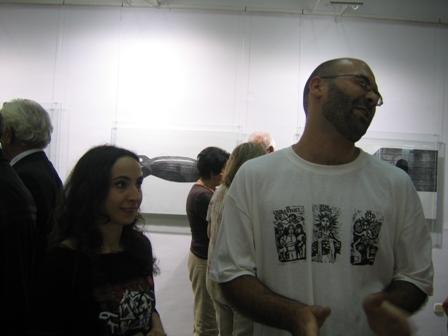
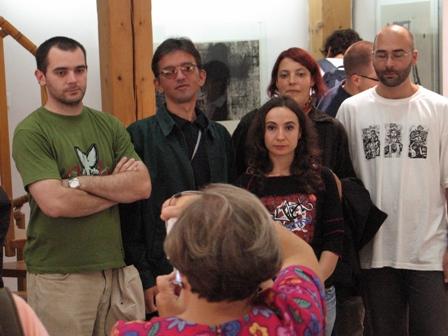
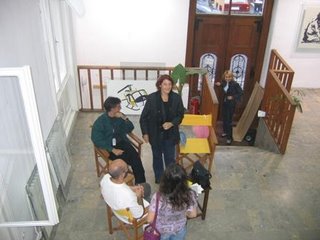
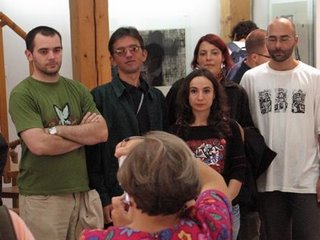
Last week our group Liht Blau had an exhibition opening in gallery
CENTER FOR PRINTING AND VISUAL RESEARCH in Belgrade.
“But he has nothing on at all,” said a little child at last. “Good heavens! Listen to the voice of an innocent child,” said the father, and one whispered to the other what the child had said. “But he has nothing on at all,” cried at last the whole people. That made a deep impression upon the emperor, for it seemed to him that they were right; but he thought to himself, “Now I must bear up to the end.” And the chamberlains walked with still greater dignity, as if they carried the train which did not exist.
The Emperor’s New Suit by Hans Christian Andersen (1837)
Naturally the emperor and chamberlains could not permit themselves to look stupid. After all, both state and independent media were under their thumb, and somehow they would find the way to make someone believe in something. On the other hand, the tailors found their interest in the whole matter too. Thanks to their fortune made by having designed a suit for the emperor, they established a fund for the development of contemporary art and opened schools where they would disseminate their aesthetic theory. They created their own aesthetics in order to justify the emperor’s nudity. And the very emperor was praised for his openness and superior sensibility. It did not take a lot of time to convince people that they did not understand aesthetics, because they had no idea what it was.
After a certain period of time, the majority of imperial artists realised how superior new tendencies were. They were told that was the way it was being done in the world. And they believed it, because most of them have never been abroad, maybe as tourists, and a long time ago. They believed the tailors in order not to look stupid.
One should not overestimate human vanity. Not all believed in the things that were being praised. But, one must not forget that the emperor’s new suit was a sort of test, not only a test of intelligence, but also of professional skills. Those who could not see the emperor’s new suit, said Andersen, were not only stupid, but they were also incompetent in their line of work. Certainly the father of that indiscrete child was fired immediately after the parade. And others lived happily every after, or the way they found it convenient.
It should be mentioned that everything took place in a small, remote and primitive country. It would not be possible any other way.
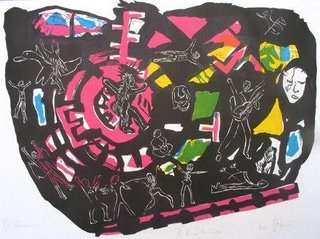
Moral: Licht Blau Art Group has nothing to lose. All of its members are unemployed. Therefore, they take the liberty to criticise the aesthetics of the emperor’s nudity in a discrete way using those classic, “old fashion” graphic art techniques. They aspire to confront the art of “modern creators” by means of achieving, first of all, the quality of their personal expressions in the materials that are traditionally accepted. By the way, for the sake of proper understanding, Licht Blau Art Group is well acquainted with the things that are being done in the world at the moment.
We leave to the public to judge our current achievements and we promise even better works and new exhibitions in future.
By Licht Blau Art Group
Deuchar explained that our job was to go round shows for a year and choose the ones we wanted to nominate (he suggested we should each choose six), then meet again in May 2006 to hammer out the shortlist of four. The chosen artists would then have a few months to prepare their individual shows for the Tate and we would finally meet again in December 2006 to choose the winner.
It sounds simple but actually the rules are quite weird. The artists have to be under 50 and born in or living and working in Britain. The age cut-off is sensible enough, but how long do artists have to live here to qualify? Could they commute? And - this is the bit the public never understands - the artists have to be nominated for a particular show, not a body of work.
full article
http://arts.guardian.co.uk/features/story/0,,1884681,00.html
==============
note it says "born in Britain" = which means that every British born Australian artist is eligible for consideration.
Q. How many British Australian shows have ever been considered for this prize?
Yeah right
==============
The age cut-off is sensible enough
Still discriminating against age. The brits are currently in the process of introducing age discrimination legislation for the workplace. The same legislation that Australia has had since the seventies.
Mature age artists need not apply.
Sept. 30, 2006 - Jan. 15, 2007
New York Hall of Science
Organized by:
Art & Science Collaborations, Inc. (ASCI)
The aim of this exhibition is to explore how the health, medical, biosciences and biotechnologies are influencing the content of contemporary art through the lense of the digital print medium.
http://www.asci.org/index2.php?artikel=821

Deborah Cornell's "Species Bounday: Wind Map" looks at the geoanalysis of wind currents affecting the migration of physical matter (including genetic escapes) worldwide;
images
http://www.asci.org/index2.php?artikel=822
Juror Statements & Bios
http://www.asci.org/index2.php?artikel=797
+++++++++++++
ASCI was one of the first organizations in the world to recognize the digital print as a valid fine art medium in 1998 by organizing an afternoon panel discussion, "Collectibility & the Digital Print". It was held in Great Hall at Cooper Union, New York City, in conjunction with our first international digital print competition / exhibition.
Click here to visit our previous Digital Print Shows
Press Release
Tuesday, 26 September 2006
DACS and Fine Art Trade Guild joint decision on prints
The Design and Artists Copyright Society (DACS) and the Fine Art Trade Guild have set their guidelines on the inclusion of limited edition prints under the Artist's Resale Right legislation.
The issue of limited edition prints was one area that was not clearly
defined in the Artist's Resale Right Regulations 2006 which merely
states that any art work "which is one of a limited number made by the
artist or under his/her authority" qualifies. The law does not state an
upper limit on the number of items in an edition.
'The Fine Art Trade Guild is delighted that DACS has reconsidered its
interpretation of the categories of prints subject to ARR, effectively
eliminating most reproductions,' says Managing Director Christrose
Sumner.
Joanna Cave, Chief Executive of DACS says, 'By consulting the Guild, in
addition to taking legal advice and studying how the issue is treated in
other countries, our goal was to reach an outcome that made sense for
art market professionals, balanced with the rights of artists. I think
we have successfully achieved this.'
DACS recommends that prints made entirely by the artist or where the
artist made the matrix and worked in collaboration with another party
will qualify.
Therefore, prints within these categories which are bought directly from
a publishing house and then resold will qualify for a resale royalty
(providing other conditions are met).
This is defined in more detail in Categories A-C of the British Standard
Classification of Prints.
For more information contact Tania Spriggens on 020 7553 9052
Notes:
What is the Artist's Resale Right?
From 14th February 2006 living artists are legally entitled to receive a
resale royalty each time their work is resold by or to an art market
professional.
Why DACS?
For 20 years artists have trusted DACS to collect and pay. Artists can
only receive their resale royalties through an organisation like DACS.
We are an ethical, genuinely not-for-profit society established by
artists for artists.
How does it work?
Our dedicated team monitors sales of art works that take place not just
in London but throughout the UK and overseas. Using this information we
calculate the royalties and collect the money due to artists. Our
sophisticated systems offer a range of services for art market
professionals whether large or small to help them comply with the law.
When will artists get paid?
DACS is committed to paying artists their resale royalties as soon as
possible. We promise to pay artists who have registered with us within
30 days of collection.
What does DACS charge?
We will only charge artists what it costs us to collect and pay. For all
resale royalties collected on or after 14th February 2006 we will charge
15%. What's more, until the true costs are known, we guarantee to match
any other rate.
Money from overseas
We have established an international network to collect resale royalties
for UK artists from overseas. Money is already coming in from around the
world. DACS will make no charge to artists when we pay these royalties.
http://www.dacs.org.uk/
DACS - the Design and Artists Copyright Society - is the UK's copyright and collecting society for artists and visual creators. We exist to promote and protect the copyright and related rights of artists and visual creators.
http://www.fineart.co.uk/
The Guild represents the art and framing industry and is its voice to government, the media and other agencies.